Origin & evolution
Carnatic music's theoretical roots extend to the Natya Shastra and the Silappatikaram, the ancient Tamil epic. However, its systematic codification is attributed principally to Purandara Dasa (1484-1564), the Kannada saint-composer who is reverentially called the Pitamaha (grandfather) of Carnatic music for systematising the pedagogical framework: graded exercises, the Mayamalavagoula raga as the starting raga for teaching, and the sequence of learning from sarali to geetham to varna to kriti.
The tradition was further structured by Venkatamakhi (17th century), who developed the Melakarta system classifying ragas into 72 parent scales and deriving scales from them, a system that still organises the Carnatic raga grammar today.
The tradition reached its highest compositional flowering in the late 18th and early 19th centuries with the Musical Trinity: Tyagaraja (1767-1847), Muthuswami Dikshitar (1775-1835) and Syama Sastri (1762-1827), all working within a generation of each other in the Thanjavur region. Their kritis (compositions) form the central repertoire of every Carnatic concert today. Tyagaraja alone composed over 700 works, primarily in Telugu, expressing intense personal bhakti (devotion) to Rama. Dikshitar composed over 450 works primarily in Sanskrit, integrating elements of Hindustani music. Syama Sastri, the least prolific of the three, is celebrated for his rhythmic sophistication and the emotional intensity of his compositions to Kamakshi.
Why Carnatic Music
The structural building block of Carnatic music is the raga, a melodic framework defined not merely by its ascending and descending scale but by characteristic phrases, ornaments (gamakas), time of performance, emotional character and the specific rules governing how individual notes are approached and departed. There are over 72 parent (melakarta) ragas and hundreds of derived (janya) ragas. No two ragas are identical in character: Bhairavi and Todi may share notes but their phrase vocabulary and emotional register are entirely distinct.
Rhythm is governed by the tala, a cyclical pattern. The Carnatic tala system is built on seven basic talas, each with multiple varieties, generating a total of 108 talas. The most commonly used in concert is Adi tala (8 beats). The relationship between raga and tala in a performance is the site of the music's improvisational creativity.
A typical Carnatic concert begins with a varnam or composition and proceeds through alapana (unmetered exploration of a raga), niraval (variations on a composition's line) and kalpana swara (improvised solfege passages), before the main composition. The concert's final section traditionally includes a pallavi (a single line improvised and developed at length), followed by lighter pieces, thillana and mangalam. The violin is the primary melodic accompaniment, joined by mridangam and sometimes ghatam or kanjira.
The tradition & its craft
Carnatic music is transmitted through intensive guru-shishya training. A student may spend years mastering the basic exercises (sarali varisai, alankarams), learning geethas, varnams and then the compositional repertoire of the Trinity and later composers before beginning public performance. The tradition values both technical precision and the ability to improvise within the raga's grammar.
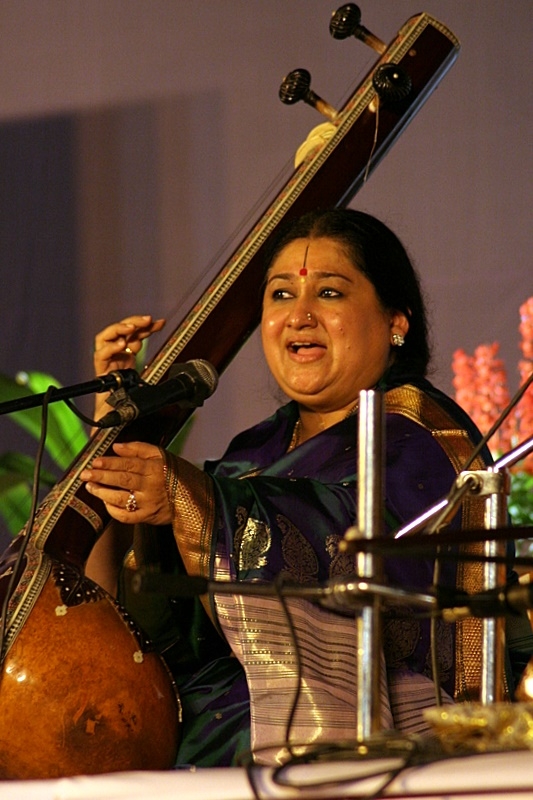
The form distinguishes between vocal (gayaki) and instrumental traditions. The vocal tradition is primary, and instrumental performances typically follow the concert format established by vocal concerts. Principal instruments include the veena (the instrument of Saraswati and the symbol of the tradition), violin, venu (bamboo flute), nadaswaram (large oboe-like wind instrument) and mridangam (double-headed drum). The violin entered the Carnatic tradition through Baluswami Dikshitar, brother of Muthuswami Dikshitar, who adapted it from the Western orchestra and created the violin's specific role in Carnatic accompaniment.
Types & forms
Masters across the generations
Signature works
In cinema & popular culture
Carnatic music's relationship with Tamil and Telugu cinema is deep and enduring. From the 1930s onwards, film songs drew on Carnatic raga structures, and many of Tamil cinema's legendary composers, including Ilayaraja and A.R. Rahman, trained formally in the tradition. Ilayaraja's background in both Western classical and Carnatic traditions is central to understanding his compositional method. The Carnatic raga Hindolam underpins some of the most recognisable background scores in Tamil cinema. In Telugu films, the tradition has been even more directly cited, with many films featuring classical vocal sequences as narrative set pieces.
Contemporary presence
Carnatic music has embraced digital platforms more rapidly than most Indian classical traditions. Several senior artists, including T.M. Krishna and Bombay Jayashri, have large YouTube and Spotify audiences. The Margazhi season in Chennai (December-January) draws international audiences and media coverage that positions Carnatic music as a globally significant arts festival. The fusion strand, crossing with jazz, Western classical and electronic music, has produced critically noted collaborations including those of Shakti (John McLaughlin and Zakir Hussain incorporating Carnatic traditions) and U. Srinivas with various Western artists. The tradition has a particularly strong presence in the South Asian diaspora in the United States, where organisations like the Cleveland Thyagaraja Aradhana sustain a robust festival circuit.
Across the regions
Carnatic music is most concentrated in Tamil Nadu, where Chennai's Margazhi season (December-January) is the world's largest classical music festival, with over 1,000 concerts at dozens of sabhas across the city over six weeks. The tradition is also strongly rooted in Karnataka (where it is called Karnataka Sangeetha), Andhra Pradesh and Telangana, and Kerala.
The music of the tradition has been transmitted globally through the South Indian diaspora, with significant institutional infrastructure for teaching and performance in the United States, Canada, Australia, Singapore, Malaysia and the United Kingdom. The Carnatic music community has been an early adopter of digital platforms for learning and dissemination, and several leading musicians now have large YouTube audiences internationally.
Where it lives
Recognition & status
Further reading
The Atlas perspective
Carnatic music is one of the great classical traditions of the world, and its profile on Culture Atlas reflects its scope: it is the music of the Tamil, Kannada, Telugu and Malayalam speaking worlds, each with their own institutional ecosystems, and it also has a global dimension through diaspora communities.
The form's score of 9.3 reflects its breadth of practice, its institutional depth, its documented compositional legacy and its living transmission. The primary gap in the Atlas's current coverage is the Karnataka Sangeetha tradition specifically, where institutional and practitioner profiles are underrepresented relative to the Tamil Nadu-centred documentation. This is an active area for future enrichment.