Origin & evolution
Kathak originates with the kathakars, temple storytellers who narrated Hindu epic and Puranic stories through gesture, music, and movement. From temple settings, the form moved into Mughal and Nawabi courts, absorbing Persian aesthetic influence and evolving its characteristic blend of Hindu bhakti and courtly elegance. Three gharanas formed: Lucknow (emphasising lyrical expressiveness under Nawab Wajid Ali Shah and the Maharaj family), Jaipur (emphasising vigorous footwork under Rajput patronage), and Banaras (an intermediate style). The twentieth century saw codification and institutionalisation, with Birju Maharaj of the Lucknow gharana becoming the form's most celebrated twentieth-century figure. Kathak is one of India's eight Sangeet Natak Akademi-recognised classical dance forms.
Why Kathak
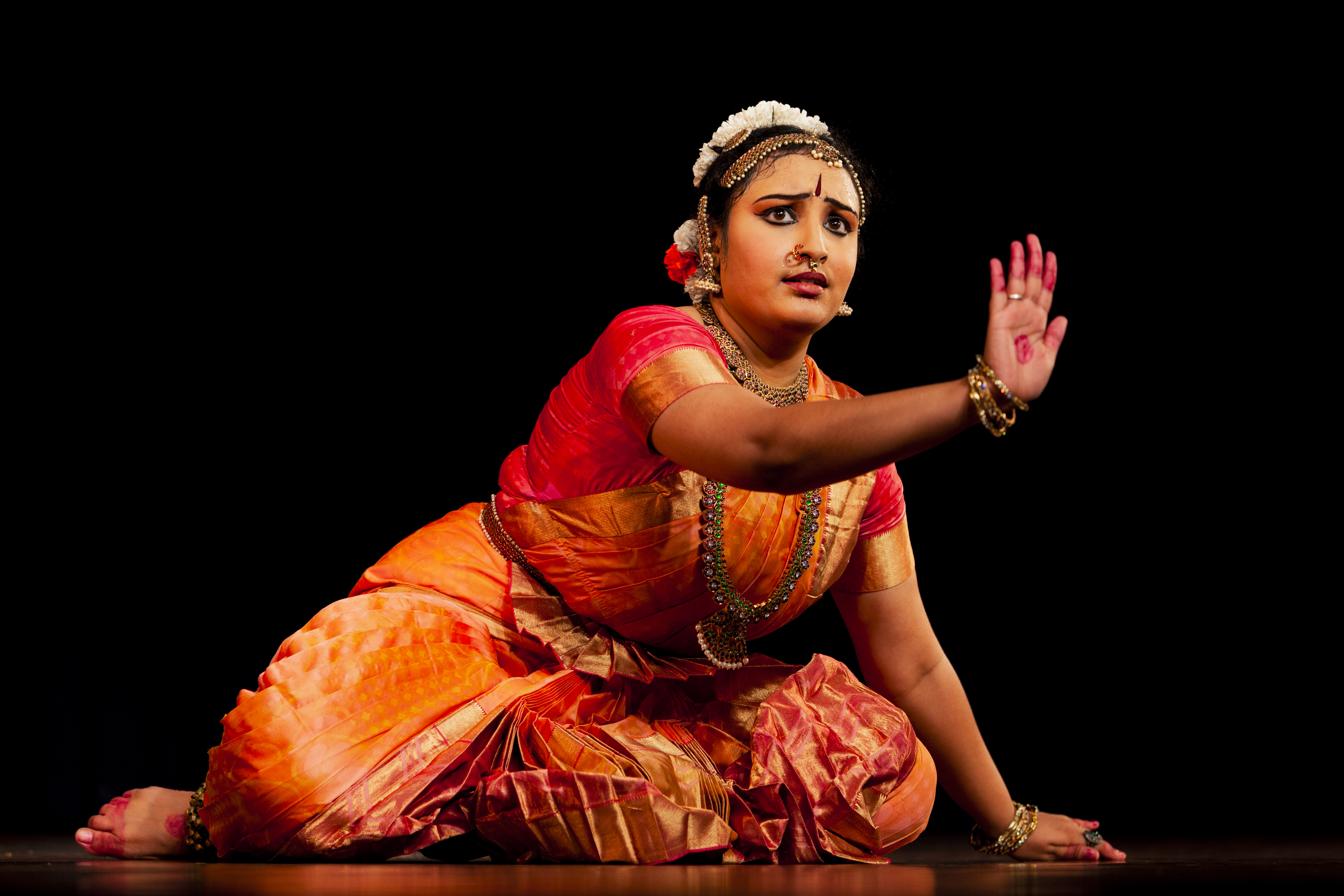
Kathak balances nritta, pure rhythm, in the percussion of ghungroo against the floor and the tabla's answering dialogue, and in the chakkar, the rapid sustained spin that is Kathak's most distinctive movement, with abhinaya, the expressional work in which the dancer becomes Radha pining for Krishna, or the beloved watching the beloved depart, rendering every syllable of a thumri through face and gesture. A Kathak performance is a negotiation between mathematics and emotion: the tihais, the calculated rhythmic phrases that resolve precisely on the beat, are a form of mathematics; the padam, the slow expressional piece, is something closer to dream. The ghungroo, the ankle bells of 50 or 100 or 200 units, are not ornament but instrument: their sound against the floor is as precise as the tabla.
The tradition & its craft
A formal Kathak presentation typically opens with an invocatory vandana, proceeds through that, tukras, and tihais demonstrating rhythmic mastery in dialogue with the tabla, and reaches its emotional centre in the abhinaya pieces: padams, thumris, and bhajans. The footwork (tatkar) is the technical foundation, with the tabla player a genuine musical partner rather than accompaniment. The chakkar (spinning turn) is Kathak's signature movement. Music is Hindustani: tabla, pakhawaj for some presentations, and vocals for the abhinaya sections. The Lucknow style uses graceful, fluid upper-body movement; the Jaipur style is more forceful and earthed.
Types & forms
Masters across the generations
Signature works
In cinema & popular culture
Kathak has shaped Hindi film dance more than any other classical form. Birju Maharaj choreographed landmark dance sequences for Devdas (2002), Umrao Jaan (1981), Bajirao Mastani (2015), and Dedh Ishqiya (2014), among others. The classical dance number in mainstream Hindi cinema draws primarily on Kathak vocabulary. Kathak's influence is also evident in mujra sequences and Bollywood's broader visual language of North Indian courtly dance.
Contemporary presence
Kathak has the broadest contemporary reach of any Indian classical dance form after Bharatanatyam, combining a strong institutional base through Kathak Kendra in Delhi with a vibrant independent performance circuit. Choreographers including Birju Maharaj (d.2022), Kumudini Lakhia and Uma Sharma shaped 20th-century Kathak, while younger practitioners including Shinjini Kulkarni and Aditi Mangaldas continue to expand its choreographic vocabulary. The form has a significant presence in Hindi film through the influence of its movement grammar on classical-influenced film choreography. Internationally, Kathak is taught and performed across the South Asian diaspora worldwide.
Across the regions
Lucknow (Lucknow gharana, seat of the Maharaj family and Kathak Kendra), Delhi (Kathak Kendra, national institution), Jaipur (Jaipur gharana, Rajasthan), Banaras / Varanasi (Banaras gharana). Taught and performed in every major Indian city. Internationally active in the UK, US, and wherever the Indian diaspora maintains classical arts institutions.
Where it lives
Recognition & status
Further reading
The Atlas perspective
Kathak is the classical dance form with the greatest cultural footprint in North Indian life, extending from the dedicated classical stage through the mehfil to the Hindi film. Its influence on mainstream culture through cinema gives it a reach that no other classical form in India matches. The gharana system is both its richness and its complexity: the Lucknow and Jaipur schools, while part of the same tradition, represent genuinely different aesthetic visions, and serious practitioners are trained within one. For programme curators and cultural institutions, Kathak is among the most versatile of classical forms: it can be presented as pure classical recital, as court-style mehfil, as collaborative performance with Hindustani vocalists or instrumentalists, or in more contemporary interpretive frameworks. The form's connection to thumri, ghazal, and Hindi poetry through its abhinaya repertoire also makes it particularly well-suited to literary and language festivals.