Origin & evolution
Odissi has one of the most thoroughly documented archaeological bases of any Indian classical dance. Carvings in the Udayagiri and Khandagiri caves near Bhubaneswar, dated to the 2nd century BCE, show dance poses that parallel the form's current vocabulary. The 12th-century Konark Sun Temple's 108 carved karanas (dance positions) and the Jagannath Temple at Puri's architectural documentation of dance confirm continuous practice through the first millennium CE.
The primary custodians of the tradition were the Maharis, female temple dancers dedicated to Lord Jagannath at the Puri temple, who performed devotional seva (service) as ritual offering. A parallel tradition of young male dancers known as Gotipuas (literally small boys) performed outside the temple, dressed as women, in devotional pieces associated with Krishna.
Odissi, like all temple dance traditions, was devastated by the colonial-era anti-nautch movement of the 1890s, which stigmatised and eventually criminalised temple dancing. By the early 20th century the Mahari tradition had nearly died out. The Gotipua tradition, less directly affected, continued.
The modern reconstruction began in the late 1940s. Four gurus, working partly independently, recreated the form from temple sculptures, palm-leaf manuscripts and the surviving knowledge of elderly Maharis and Gotipuas: Guru Pankaj Charan Das, Guru Kelucharan Mohapatra, Guru Deba Prasad Das and Guru Mayadhar Raut. The Kala Vikash Kendra, founded in Cuttack in 1952, was the first institutional centre for the form. Sangeet Natak Akademi recognition came in the late 1950s.
Why Odissi
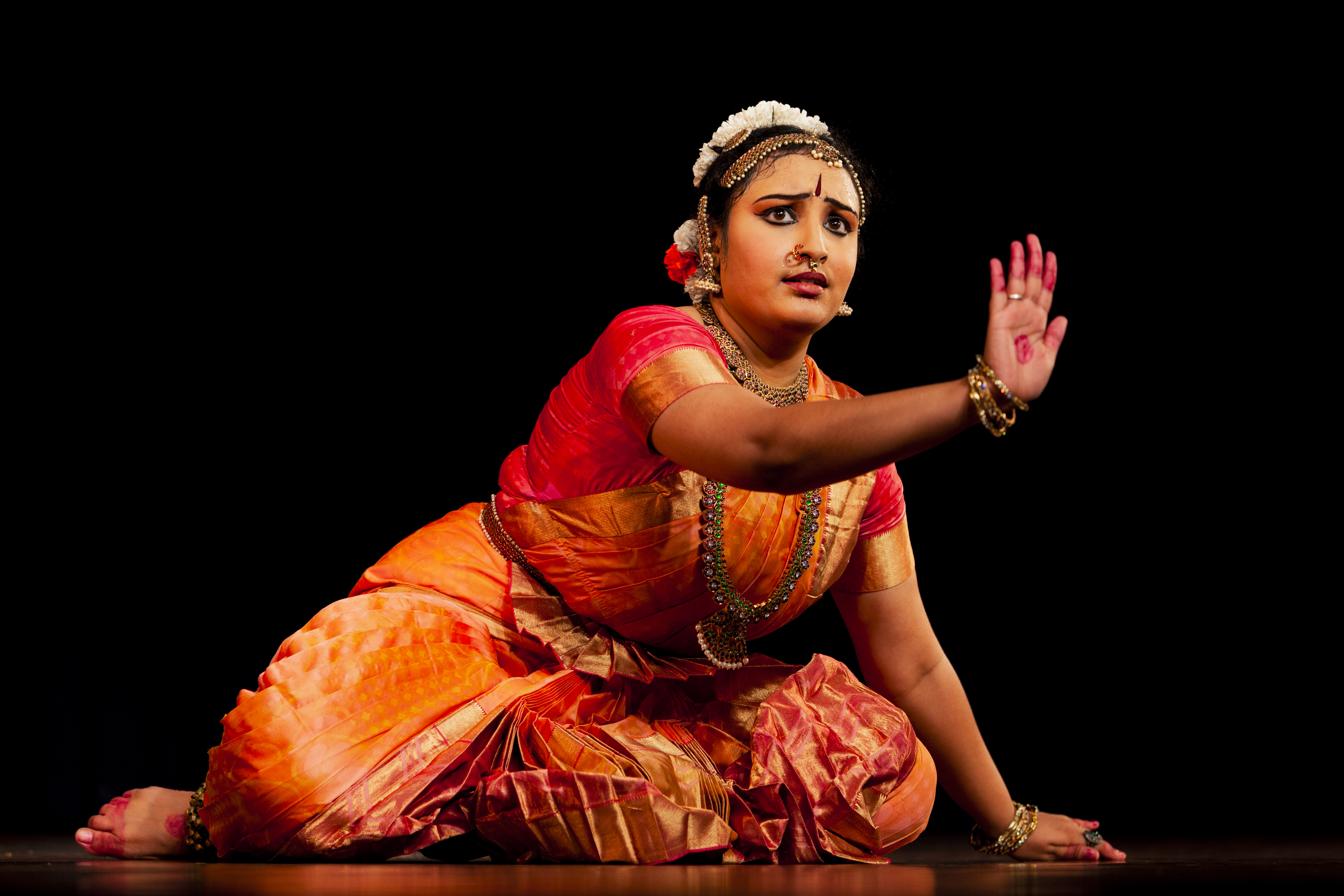
Odissi's most distinctive physical signature is the tribhanga (triple bend): the body is divided at three points, the head tilted one way, the torso the opposite, and the hip shifted to one side, creating an S-curve that echoes the temple sculptures and gives the dance its particular quality of lyrical grace. The chauka (square), another fundamental stance, is more grounded, with the feet flat and the knees bent outward, used for powerful passages and male characterisations.
A traditional Odissi recital follows a structured sequence: Mangalacharan (invocation), Batu or Sthayee (abstract nritta based on the Nataraja posture), Pallavi (elaboration of a raga through movement), Abhinaya (expressive piece, typically a Odia lyric or Ashtapadi of Jayadeva), and Moksha (the concluding piece, expressing liberation). The Ashtapadi of Gitagovinda, the 12th-century Sanskrit poem by Jayadeva on the love of Radha and Krishna, is the central literary text of the Odissi abhinaya tradition.
The tradition & its craft
The four gurus who reconstructed Odissi produced distinct styles that are now recognised as the four gharanas of the form: the Pankaj Charan Das style (emphasising the Mahari tradition and the Gotipua acrobatic vocabulary); the Kelucharan Mohapatra style (the most widely taught, characterised by lyrical grace and comprehensive abhinaya); the Deba Prasad Das style (influenced by Uday Shankar's creative choreography); and the Mayadhar Raut style (noted for its academic approach to the Natya Shastra). Kelucharan Mohapatra's students, including Sanjukta Panigrahi, Sonal Mansingh, Madhavi Mudgal and Kumkum Mohanty, became the next generation's most prominent exponents and teachers.
Odissi is accompanied by Odissi classical music, with the mardala drum, flute and singing. The compositions most associated with Odissi are from the Panchasakha tradition of medieval Odia Vaishnavism and the Gitagovinda of Jayadeva.
Types & forms
Masters across the generations
Signature works
In cinema & popular culture
Odissi has been less directly represented in Hindi cinema than Bharatanatyam or Kathak, but its visual grammar has influenced several films with Odia settings. The internationally acclaimed Odia filmmaker Satyajit Ray included Odissi-influenced material in several of his films. Contemporary Odia cinema regularly features Odissi sequences. The form's sculptural quality has made it a subject of photography and documentary filmmaking: Mani Kaul's film Siddheshwari (1989) documents Siddheshwari Devi and adjacent traditions.
Contemporary presence
Odissi has achieved strong international recognition through the touring careers of Sonal Mansingh, Madhavi Mudgal and the students of Kelucharan Mohapatra who have taught across India and internationally. The Konark Dance Festival (December) is the most important annual platform, drawing major practitioners from across India to perform against the backdrop of the 13th-century Sun Temple. The form has a substantial presence in the United States and Canada through diaspora institutions. Contemporary Odissi choreographers have extended the form's repertoire beyond the Gitagovinda texts to include new compositions while retaining the technical vocabulary.
Across the regions
Odissi's institutional base is in Odisha, with Bhubaneswar and Puri as the primary centres. The Odissi Research Centre (now the Guru Kelucharan Mohapatra Odissi Research Centre) in Bhubaneswar and Utkal Sangeet Mahavidyalaya are the most significant training institutions. The Konark Dance Festival, held annually at the Sun Temple in Konark, is the most important platform for the form.
Odissi has spread significantly beyond Odisha through the teaching careers of Kelucharan Mohapatra's students. Sonal Mansingh based in Delhi, Madhavi Mudgal in Delhi and Sanjukta Panigrahi (based in Europe before her death in 1997) trained large numbers of students across India and internationally. The form has a particularly strong presence in the United States and Canada through the diaspora.
Where it lives
Recognition & status
Further reading
The Atlas perspective
Odissi connects on the Atlas graph to the Bhubaneswar and Puri destination profiles, to the Konark Dance Festival profile, and to several artist profiles. The form's score of 9.0 reflects its deep historical documentation, its living transmission across a large network of practitioners, and its international reach through the diaspora. The primary gap in the Atlas's coverage is the Mahari tradition itself, which is now largely extinct, and the Gotipua tradition, which continues as a distinct form and deserves its own documentation.