Origin & evolution
Mohiniyattam traces its roots to the temple dance traditions of Kerala and to the mythology of Mohini, the divine enchantress. The name derives from 'Mohini' (the enchantress) and 'attam' (dance in Malayalam). The form took courtly shape under Maharaja Swathi Thirunal of Travancore (r. 1829-1847), a prolific composer who created much of the extant repertoire in Manipravalam. Under early twentieth-century social reform, the form nearly disappeared as part of the suppression of Devadasi arts. The revival began in 1930 when Vallathol Narayana Menon founded the Kerala Kalamandalam; Kalamandalam Kalyanikutty Amma codified the technique and trained the next generation. Kalamandalam Kshemavathy and Bharati Shivaji expanded the repertoire and scholarly base. Today Mohiniyattam is one of India's eight recognised classical dances.
Why Mohiniyattam
If Kathakali is Kerala's thunder, Mohiniyattam is its rain. Every element of the form is governed by lasya, the aesthetic of the gentle, the lyrical, and the swaying. The body is never percussive; it curves. The torso moves in a characteristic side-to-side sway called chalukal, evoking paddy in wind, palms in a breeze. The eyes move softly, following the gesture rather than leading it. The music is Sopana style, a slow, meditative soundscape that shapes the form's unhurried pace. The verses are in Manipravalam, a hybrid of Sanskrit and Malayalam that belonged to the courts of medieval Kerala. To watch Mohiniyattam is to understand that femininity, in the grammar of this form, is not passivity but precision: the precision of a wave, of a flame, of water.
The tradition & its craft
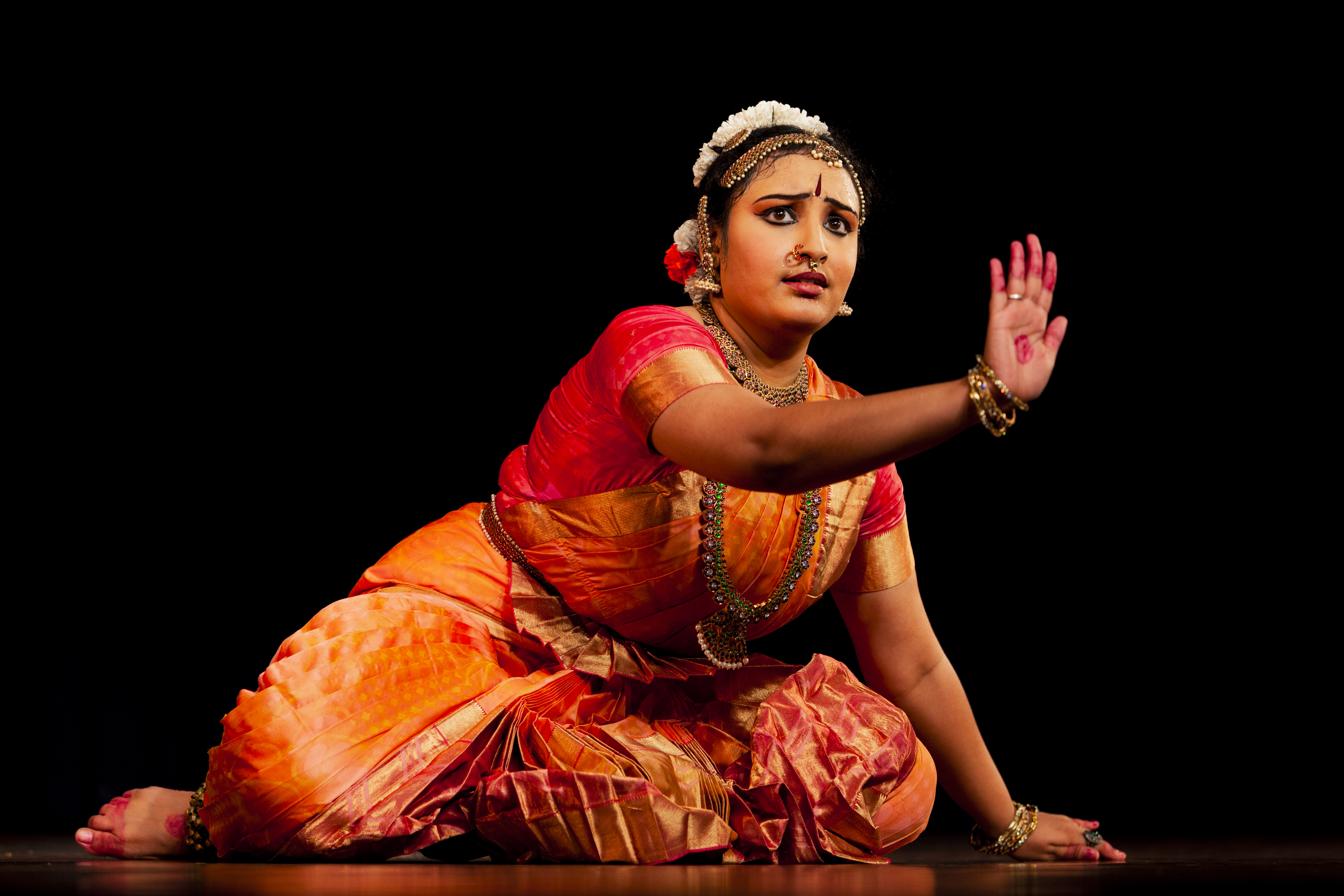
The primary repertoire items are cholkettu (an invocatory number), jatiswaram, varnam, padam, and tillana. The varnam is the centrepiece, combining pure rhythm with storytelling, usually devotional. The padams are slow, expressional numbers in which the dancer renders the meaning of the Manipravalam text through gesture and facial expression. Technique demands mastery of the hastha mudras as codified in the Hastha Lakshanadeepika, a Kerala text specific to the form, as well as the characteristic footwork patterns and the torso-sway. Music is provided by a vocalist, mridangam, veena, flute, and often idakka. Costume is white and gold, with jasmine flowers in the hair and the distinctive circular hair arrangement at the side of the head.
Types & forms
Masters across the generations
Signature works
In cinema & popular culture
Mohiniyattam appears in Malayalam cinema and in classical-themed productions, most often as a marker of Kerala's refined cultural identity. It has been featured in several documentary projects on Indian classical arts. Its visual aesthetic, the white and gold costume and swaying grace, is one of the most recognisable icons of Kerala's cultural identity in national media.
Contemporary presence
Mohiniyattam's exclusively female performance tradition is maintained primarily within Kerala. The form's lyrical, flowing quality makes it visually distinctive among Indian classical dance forms. Kalamandalam Kshemavathi, Sunanda Nair and their students have contributed significantly to the form's contemporary development. International performance opportunities have grown since the 1990s through Indian cultural diplomacy and diaspora networks, though the form's international reach remains smaller than Bharatanatyam or Kathakali.
Across the regions
Mohiniyattam is Kerala's own form and is primarily taught and performed there, with the Kerala Kalamandalam at Thrissur as its institutional home. It is now taught and performed in major Indian cities and across the diaspora, particularly in the United States, the Gulf, and the United Kingdom. Bharati Shivaji's work at Mohiniyattam Kendra in New Delhi has been central to the form's national visibility.
Where it lives
Recognition & status
Further reading
The Atlas perspective
Mohiniyattam is among the most compositionally unified of India's classical dance forms: its aesthetic range is narrower than Bharatanatyam or Odissi, and that narrowness is its discipline. Every element, the swaying torso, the soft eye movements, the lateral walk, the Sopana-inflected music, serves a single aesthetic purpose. This makes it less spectacular than Kathakali and less immediately accessible than Bharatanatyam, but for audiences with patience and aesthetic literacy, it offers an experience that the louder classical forms cannot. The form's twentieth-century revival is a model of what deliberate institutional effort can achieve: Vallathol's Kerala Kalamandalam, Kalyanikutty Amma's codification work, and Bharati Shivaji's scholarship together rebuilt a tradition from near-collapse into a globally performed form. Its status as one of India's eight Sangeet Natak Akademi-recognised classical dances confirms its institutional standing.