Origin & evolution
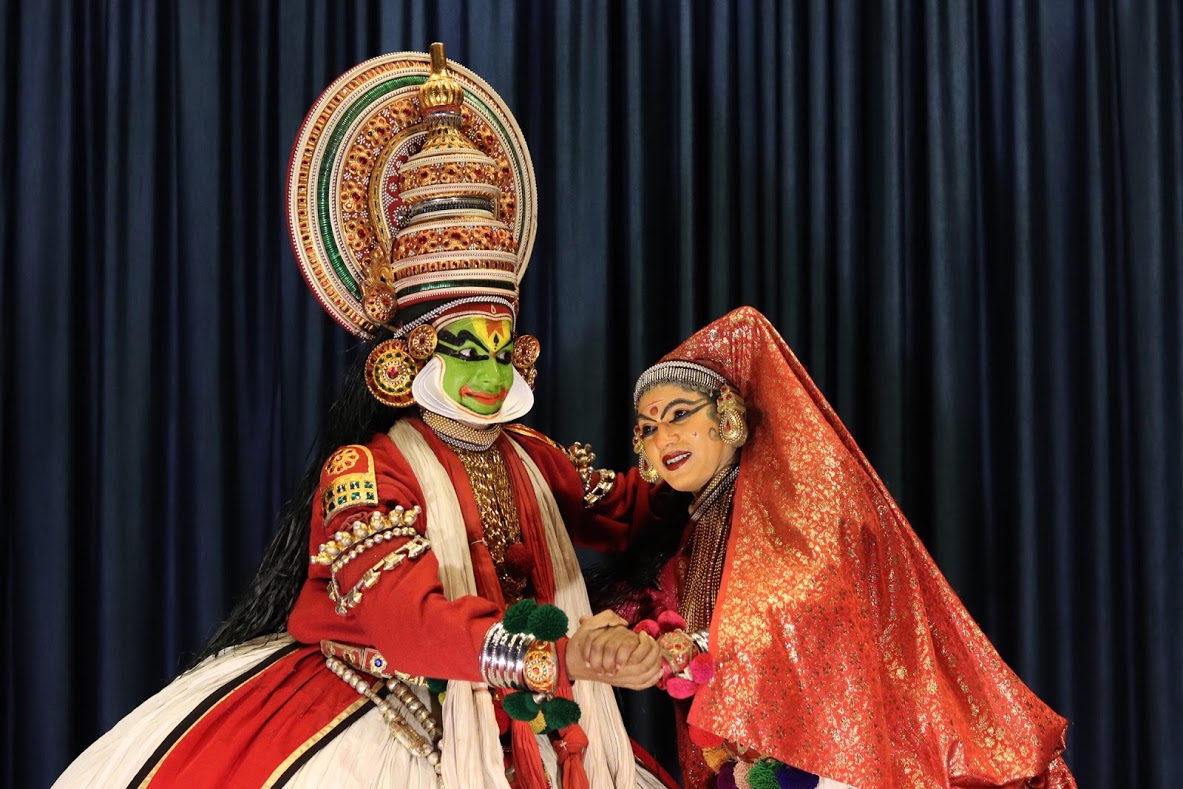
Koodiyattam means combined acting in Malayalam, describing its essential feature: multiple characters on stage together, performing a Sanskrit play. The form combines Sanskrit theatre with Koothu, an ancient performing art from the Sangam era of Kerala's cultural history, which itself predates the Sanskrit influence.
The form's documented history in Kerala extends to the 10th century CE, when Kulashekhara Varma of the Chera dynasty is credited with establishing the performance conventions that link the Koothu tradition to the classical Sanskrit plays of Bhasa, Harsha and other dramatists. The plays are drawn primarily from the great Sanskrit dramatists and performed in the Koothambalams, the special theatre structures within Kerala temples that are themselves among the oldest surviving theatre spaces in the world.
Koodiyattam was the exclusive hereditary property of two castes: the Chakyar community performed the male roles using the detailed Attaprakaram performance manuals; the women of the Nambiar community performed as the Nangyar, the female narrator figure, using the Kramadipika. The Nambiar community also played the mizhavu, the large clay pot drum that is Koodiyattam's distinctive percussion instrument. This caste exclusivity kept the tradition pure but also made it extremely vulnerable to social change.
The 19th century saw Koodiyattam nearly collapse as royal patronage ended. The first performance outside the temple, by Painkulam Rama Chakyar in 1949, was a significant opening. The establishment of a Koodiyattam school at Kerala Kalamandalam in 1965 broke the hereditary transmission pattern and admitted students from outside the Chakyar community.
Why Koodiyattam
A complete Koodiyattam performance of a Sanskrit play may last 40 days, with each act performed across multiple nights with extreme attention to the elaboration of every element: eye movements, hand gestures, facial expressions and the interpretation of each syllable of the text. This slowness is not a limitation but the form's aesthetic core. The actor may spend an entire night elaborating a single moment in the play, using the Navarasa (nine emotional states) system to build layers of meaning around one couplet.
The performance is governed by detailed manuals. The Attaprakaram describes the stage business for each play; the Kramadipika describes the acting conventions. These texts, maintained in palm-leaf manuscripts and passed within families, are among the most detailed performance documentation in world theatre history.
The Nangyar Koothu, the solo form performed by women of the Nambiar community, is the most intimate expression of the tradition: a single performer narrating episodes from the Srimad Bhagavata Purana through the Nangyar's distinctive combination of storytelling, facial expression and rhythmic movement.
The tradition & its craft
Koodiyattam is transmitted through two parallel channels. Within the hereditary families, transmission remains through the traditional apprenticeship: children of the Chakyar and Nambiar communities learn from their elders from childhood, using the same performance manuals that have governed the tradition for centuries. Outside the hereditary community, Kerala Kalamandalam and Margi (an institution in Thiruvananthapuram) and Nepathya at Moozhikkulam provide formal training to students from all communities, introducing a new generation of practitioners who maintain the form's technical standards while extending its social base.
The mizhavu drum, specific to Koodiyattam and unrelated to any other Indian percussion tradition, is the form's sonic signature. The maddalam and idakka are supporting percussion. No melodic instruments accompany the performance: the text, the drum and the actor's body create the complete sonic world of Koodiyattam.
Types & forms
Masters across the generations
Signature works
In cinema & popular culture
Koodiyattam has been documented in several ethnographic films and has been referenced in scholarly discussions of Indian theatre's relationship to cinema. Its influence on Malayalam cinema is indirect: the performance principles of abhinaya and the use of the face as the primary expressive instrument, developed over two millennia in Koodiyattam and Kathakali, underlie much of Kerala's theatrical and cinematic performance tradition.
Contemporary presence
Following UNESCO recognition in 2001, Koodiyattam has received significantly more institutional support and international touring opportunities than before. Kerala Kalamandalam's international touring programme has brought the form to world theatre festivals in Europe, the United States and Japan. The form is now taught to students from outside the hereditary Chakyar and Nambiar communities, both at Kerala Kalamandalam and at Margi in Thiruvananthapuram. Nepathya at Moozhikkulam (associated with Ammannur Madhava Chakyar's lineage) continues to train practitioners in both the hereditary and non-hereditary tradition. Women now perform Koodiyattam, an innovation that would have been unthinkable within the traditional temple context.
Across the regions
Koodiyattam is concentrated in Kerala, with the major institutional centres in Thrissur, Thiruvananthapuram and Kochi. The Koodalmanikyam Temple at Irinjalakkuda and the Vadakkumnathan Temple in Thrissur are the major venues for traditional temple performances. Kerala Kalamandalam's UNESCO recognition has supported international touring: Koodiyattam performances have been staged in Europe, the United States and Japan as part of world theatre festivals. The form's UNESCO status has also attracted academic interest from international theatre scholars.
Where it lives
Recognition & status
Further reading
The Atlas perspective
Koodiyattam connects on the Atlas graph to the Kerala destination profile (Thrissur and Thiruvananthapuram as primary centres), to the Kerala Literature Festival (which has featured Koodiyattam discussions and demonstrations), and to the International Theatre Festival of Kerala, which has included Koodiyattam alongside international theatre. The form's score of 8.8 reflects its extraordinary historical depth, its UNESCO recognition, and the quality of its living transmission, while acknowledging that its audience remains limited by its difficulty and the length of its full performances. The primary gap in the Atlas's coverage is the Nangyar Koothu sub-tradition, which deserves separate documentation.