About
To preserve and promote Indian languages, literature and culture, and to connect people through the many modes of literary expression.
Rekhta Foundation is a not-for-profit public charitable trust that has become the single most important force in the digital preservation of Urdu, and increasingly of other Indian languages. Through rekhta.org - the world's largest online repository of Urdu poetry - and a growing family of platforms, it has moved a script-gated literary heritage out of fragile private collections and university stacks and into free, searchable, global access.
Rekhta began with a simple barrier: Urdu's greatest poetry was locked behind a script most of its admirers could no longer read. Saraf's answer was to render the canon simultaneously in Urdu, Devanagari and Roman, so a reader anywhere could meet Ghalib or Mir at a click. The site resonated instantly and, in Saraf's own words, "acquired a life of its own."
What followed was expansion on every axis. In 2015 the Foundation launched Jashn-e-Rekhta, now the world's largest festival devoted to a single language, anchored in Delhi. It built an industrial digitisation pipeline to rescue rare and endangered books. It extended the same model to other languages (Hindi (Hindwi, 2020), Rajasthani (Anjas, 2022) and Gujarati (Rekhta Gujarati, 2024)) and to spiritual literature through Sufinama. It added learning tools and a research wing, RekhtaLabs, advancing Urdu natural-language processing. From a poetry website, Rekhta became an ecosystem.
Founding & Leadership
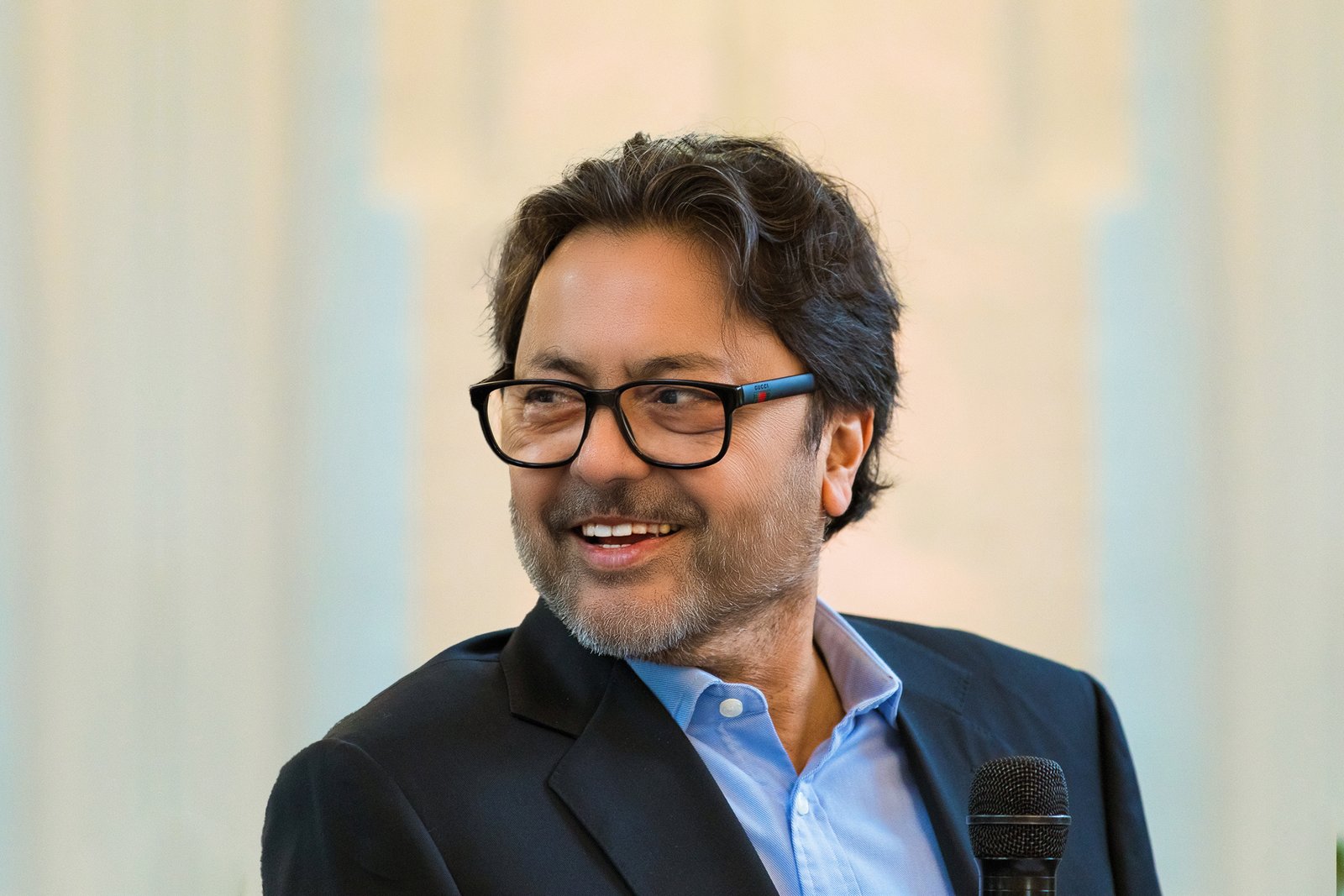
Sanjiv Saraf is an industrialist and the founder-chairman of Polyplex Corporation, one of the world's largest manufacturers of PET films. Introduced to Urdu shayari by his father, he grew up listening to ghazals and carried a lifelong love of the language, later teaching himself the Urdu script as an adult. Frustrated that the script gate kept Urdu poetry from the millions who loved it but could not read Nastaliq, he conceived an "Urdu virtual library" and pitched it to Urdu professors across leading universities - the idea that became rekhta.org in January 2013. He brought a manufacturer's discipline to cultural preservation, turning digitisation into an industrial-scale operation, and is himself the author of Love, Longing, Loss in Urdu Poetry and the curator of Wayward Verses. His personal patronage anchored the Foundation's early years.
Mixed
Public charitable trust governed by a board of trustees.
Leadership & Trustees
Initiatives & Portfolio
The world's largest online archive of Urdu poetry and literature - couplets, poet biographies, prose, dictionary and e-books in Urdu, Devanagari and Roman script.
Annual celebration of Urdu language, literature, art and culture in Delhi; the world's largest festival devoted to a single language. Its 10th edition (Dec 2025) at Baansera Park drew more than 1.5 lakh visitors across three days.
Free virtual library of over a million rare and contemporary digitised titles, sourced from libraries, private collections and volunteers.
The digital home of Hindi literature - poetry, prose, classic authors, archives and a bespoke dictionary in Devanagari.
A spiritual archive of the subcontinent's Sufi and Bhakti voices, including the largest online collection of Amir Khusrau's work.
India's first and only digital library for Rajasthani literature, documenting oral and written traditions.
The first comprehensive digital platform for Gujarati literature - poetry, folk art, rare manuscripts and modern prose.
E-learning platform to teach the Urdu script and language to new learners.
Trilingual Urdu dictionary (Urdu/Hindi/English) with poetic usage examples, plus Hindwi, Qaafiya and Taqti reference and prosody tools.
The Foundation's R&D wing, advancing AI and natural-language-processing research for Urdu and other Indic languages.
In-house multilingual publishing venture producing curated anthologies and literary titles (e.g. Love, Longing, Loss in Urdu Poetry; Wayward Verses).
Industrial-scale preservation: 85+ scanners across 40+ locations scanning ~5,000 books monthly across multiple Indian languages.
National-level Urdu poetry competition for students, nurturing a new generation of enthusiasts.
Impact & Metrics
Partnerships & Network
Partner institutions
Government partners
Funders & patrons
Records and platforms established literary figures and emerging poets from across the subcontinent; sources collections from reputed libraries and personal archives for digitisation.
Credentials & Compliance
CSR-eligible · Schedule VII(v) - national heritage, art & culture
80G and FCRA status confirmed; FCRA registration is active. 12A and CSR-1 are in force (Rekhta receives corporate CSR funding). Audited financials are not published publicly. [Atlas Estimate] on registration numbers beyond 80G - [Data Not Publicly Available].
Complies with CSR Act Section 135, Schedule VII(v) - protection of national heritage, art and culture - making it eligible for corporate CSR funding. Polyplex Corporation contributes via this route.
Recognition
Widely regarded as the largest and most authoritative digital resource for Urdu literature worldwide. Founder Sanjiv Saraf is a recipient of the Sir Syed Excellence National Award.
In the Press
Gallery


Rekhta is the most consequential act of Indian-language digital preservation of the twenty-first century. By rendering Urdu poetry simultaneously in Nastaliq, Devanagari and Roman, it dissolved the single barrier (script) that had been quietly orphaning a living literature from its own admirers. It did not merely archive Urdu; it made Urdu usable again for a generation that loved the sound of it but had lost the letters. The deeper significance is structural: Rekhta proved a replicable model and then ran it across Hindi, Rajasthani, Gujarati and Sufi traditions, turning one act of rescue into an infrastructure for many.
Rekhta's achievement is hard to overstate and worth assessing honestly. Its strengths are foundational: unmatched scale, genuine openness, real innovation (industrial digitisation, NLP research, cross-script rendering) and a rare ability to make preservation feel popular rather than academic. The open questions are about concentration and framing. Sustainability has leaned on founder patronage and founder-linked funding, which makes broadening the funding base a watch-item as the portfolio widens. Breadth across many languages strengthens the ecosystem but raises the question of whether the Urdu core stays as deep as it expands. And there is a live cultural debate over the festival's drift from "Urdu" toward a broader "Hindustani" framing, which some Urdu advocates read as dilution of the very identity Rekhta was founded to defend. None of this diminishes the accomplishment; it marks Rekhta as an institution now large enough that its choices shape the field.