The Story
OrganizerSAMAA takes its name from sama, the Arabic word for listening, and specifically for the kind of attentive listening that Sufi practice has treated for eight centuries as a devotional act rather than a passive one. The choice of name is deliberate, and it is also the clearest statement of what the festival is attempting: not a concert series with a spiritual theme, but an event organised around the premise that listening together is the point.
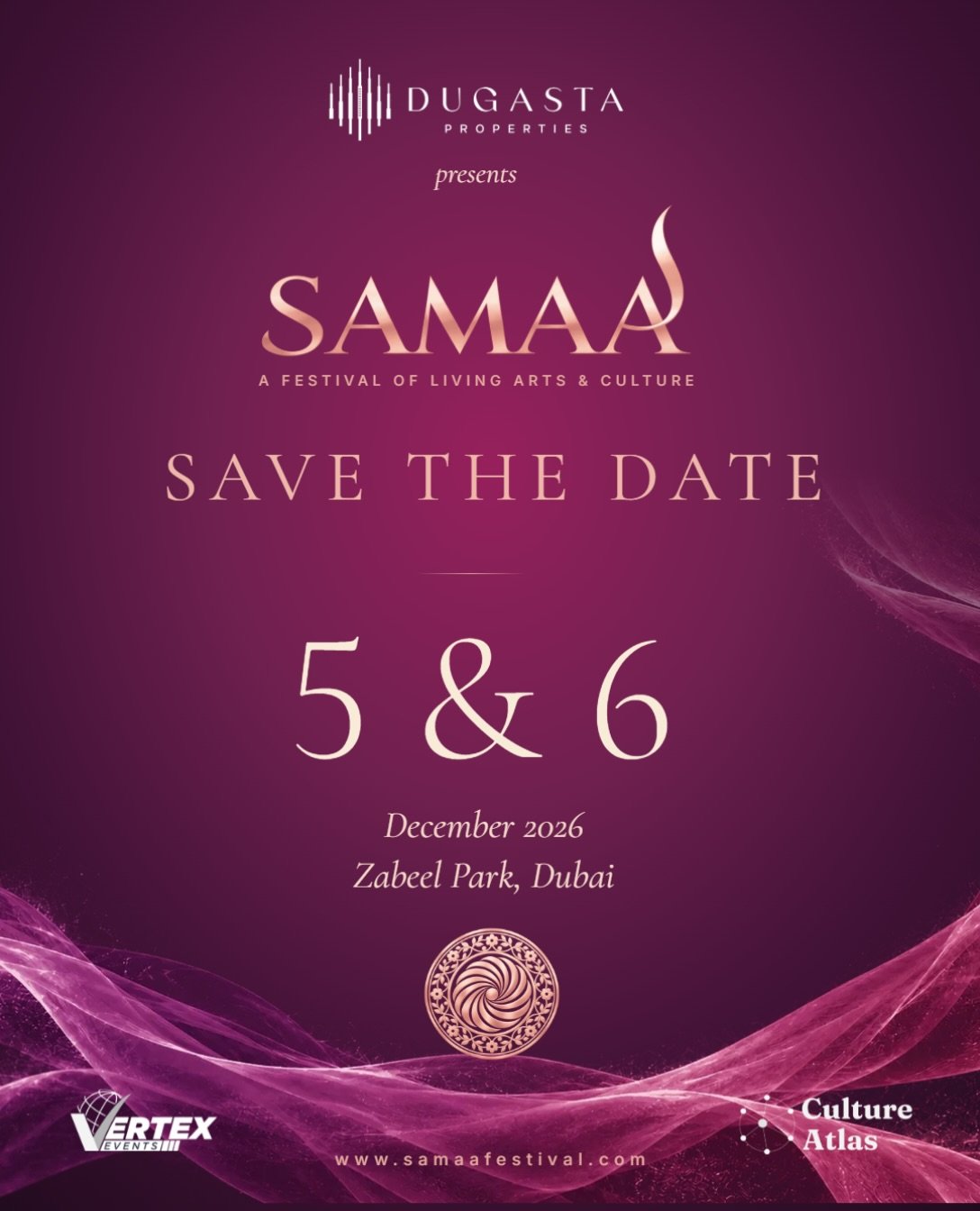
The first edition takes place at Zabeel Park, Gate 5, in Dubai on 5 and 6 December 2026, running from 3 pm to 11 pm on each of the two days. The venue is an open-air site inside a 47.5 hectare public park in the Zabeel district, between Al Karama and the Dubai World Trade Centre, and it is the park that holds the Dubai Frame. Capacity is set at 2,500 per day. That is a deliberately contained number for a city that regularly stages events an order of magnitude larger, and it says something useful about how the first edition has been scoped.
The programme is built around four components. The Mehfil-e-Samaa is the core: two evenings of live music, poetry and conversation drawing on qawwali, ghazal, Sufi and classical repertoire, performed by artists from India and Pakistan. Malika-e-Samaa is a lifetime honour for a body of work in Sufi music, structured as a recurring recognition rather than a one-off tribute. Alongside the main stage sit the Dastarkhwan, a food festival named for the cloth on which a shared meal is laid out, and an Artisan Bazaar. The four together describe an event that treats music, food and craft as parts of one cultural fabric rather than a performance with retail attached.
At the time of writing the line-up has not been announced, nor has the first Malika-e-Samaa honouree. Tickets go on sale on 1 November 2026. Dugasta Properties, a Dubai developer with a publicly announced project pipeline of 1.5 billion dirhams, is title partner, and a four-tier partnership structure sits below that: Co-Presenting, Associate, Supporting and Friends.
The festival is organised and produced jointly by Vertex Events, a Dubai event company whose publicly documented portfolio runs substantially to corporate and trade formats including a recurring blockchain summit series at Grand Hyatt Dubai, and by Culture Atlas, the cultural documentation platform on which this profile sits. Satish Gupta, founder of Culture Atlas, is a co-founder of the festival with Pushkin Agha of Vertex Events. Culture Atlas therefore holds an ownership interest in a festival it also profiles and scores. That is disclosed here rather than left to be discovered, and the scoring below is applied on the same basis as every other festival in the Atlas.
Why Dubai, and why first. The straightforward answer is the audience: the UAE holds one of the largest South Asian populations anywhere outside South Asia, and Dubai has a mature market for Indian and Pakistani music. The more interesting answer is that sama is not an imported idea in the Gulf. It is an Arabic term from Islamic devotional practice, and a festival carrying that name reads natively in Dubai in a way it would not in London or Toronto, both of which appear in the founders' stated expansion plans alongside India and Singapore. Launching in Dubai places the festival inside the tradition it draws on rather than presenting that tradition to an audience standing at one remove from it.
There is a second reason, less often stated plainly. Sustained cultural exchange between Indian and Pakistani performers has been constrained for years by the political relationship between the two states, and the Gulf has become the practical neutral ground on which it still happens. A festival whose stated proposition is artists from both countries on one stage is making use of that. The fact that this is unremarkable in Dubai and would be difficult to stage almost anywhere in the subcontinent is itself the substance of the idea.
The emblem combines a whirling rosette drawn from the dervish turn with a floral border from Mughal design, which is a fair visual summary of the festival's two inheritances: the Persian and Arab Sufi line, and the Indo-Islamic courtly tradition that produced qawwali and the ghazal as performed forms.
What the first edition does not have is a record. It has not happened. There is no attendance figure, no independent press coverage, no reviews, no returning audience, and no evidence of how the four components work together at the stated scale. The Atlas score on this profile reflects that absence and nothing else. It is a pre-edition baseline and is expected to be revised after December 2026, once there is something to assess.
Sama, in the Sufi vocabulary, is the practice of listening to music and sung poetry as a means of approaching the divine. It has been contested within Islamic jurisprudence for as long as it has been practised, defended most influentially by al-Ghazali in the eleventh century, and it is the doctrinal root from which a very large body of performed devotional music descends. The Chishti order, which carried Sufism into the Indian subcontinent from the twelfth century, made sama central to its practice in a way other orders did not, and qawwali is the direct consequence of that decision. A festival named SAMAA is therefore naming the tradition's governing idea rather than one of its outputs, and that is a more serious framing than a generic Sufi-music billing.
The repertoire the festival has indicated sits across three related but distinct forms. Qawwali is congregational, built on a lead voice, responsorial chorus, harmonium and the hand-clapping that drives its rhythmic acceleration, and it is designed to be performed at a shrine in the presence of listeners who are participants. The ghazal is a poetic form before it is a musical one, a sequence of couplets on separated themes bound by rhyme and refrain, and its semi-classical performance tradition in the subcontinent developed through the courts and the mehfil rather than the dargah. Hindustani classical music supplies the raga framework both draw on. Programming these alongside one another is defensible and historically coherent, and it is also how the strongest Sufi-music festivals in the region have tended to build their line-ups.
The specific cultural weight of this festival, if it works, lies less in the repertoire than in who performs it together. Qawwali's major lineages are divided across the 1947 border. The Sabri and Fateh Ali Khan traditions are Pakistani; the Nizami and Delhi gharana lines are Indian; the shrine circuit the form grew from runs through both countries and through the Punjab the border cuts in half. Performers from these lineages share a repertoire, a language register and a technical vocabulary, and have for decades had limited opportunity to appear on a stage together. Where that has happened recently, it has largely happened in the Gulf, in North America or in Europe rather than in Delhi or Lahore.
That makes a Dubai festival with this stated proposition a piece of cultural infrastructure rather than simply an event, provided it delivers the line-up it describes. The significance is conditional and should be read that way. An inaugural edition with no announced artists has made a claim about what it will do, and the claim is a serious one, but it is a claim.
The Dastarkhwan and the Artisan Bazaar extend the same logic into material culture. A dastarkhwan is the spread cloth around which a shared meal is eaten, and the word carries a specific connotation of hospitality extended without regard to the standing of the guest, which is the same egalitarian impulse that governs the shrine. Placing a food programme under that name alongside craft stalls frames the festival's non-musical components as continuous with its devotional premise instead of appended to it for footfall. Whether the execution honours that framing is not yet knowable.
One further point belongs here because it affects how the festival will be found and understood. At least four other festivals already use this name or a close variant: the Samaa Festival in Marrakech, now in its fifteenth edition; the Samaa International Festival for Sufi Music and Chanting in Cairo; Sama'a: Festival of Sufi Music at the NCPA in Mumbai; and a separate SAMA Festival operating internationally. All of them draw on the same Arabic root for the same reason. This is not a case of a name being appropriated. It is a case of a name being the obvious correct choice for several unrelated organisers, which is a genuine problem of distinctiveness rather than of legitimacy, and it is addressed in the Atlas commentary on this profile.
Dubai's cultural calendar is strong in some registers and conspicuously thin in others. The city supports a substantial commercial concert market, a growing contemporary art sector anchored by Alserkal Avenue and Art Dubai, a government-led programme through Dubai Culture including Dubai Art Season, and a dense circuit of trade and corporate events. What it has had comparatively little of is sustained, annually recurring programming in the classical and devotional traditions of the populations that make up most of its residents. South Asian music in Dubai has largely arrived as touring product: a named artist, a single night, a ticketed hall, and nothing that persists between visits.
That gap is the space SAMAA is aiming at, and it is a real one. A recurring festival differs from a concert in ways that matter culturally rather than commercially. It can commission. It can programme an artist who is important but not yet a draw. It can build a recognition instrument, which is what Malika-e-Samaa is intended to be. It accumulates an audience that returns, which is the only mechanism by which a city's relationship to a tradition deepens rather than simply recurring. None of this is available to a promoter booking a hall for one evening, and all of it depends on the festival reaching a second and third edition.
The timing is also legible. The Gulf states have spent the past decade investing heavily in cultural institutions, and the UAE's approach has leaned towards museums, galleries and large built landmarks. Living and performed traditions have received less structural attention, particularly those belonging to the expatriate majority rather than to Emirati heritage. A privately produced festival does not resolve that asymmetry, but it does test whether there is an audience willing to pay for it, which is the question any subsequent public or institutional support would turn on.
There is a harder present-tense reason as well. The practical space for Indian and Pakistani artists to work together has narrowed, not widened, over the last several years. Touring between the two countries is effectively closed. Collaborations that once happened at home now happen abroad or not at all. For audiences in both diasporas, a shared stage in a third country is increasingly the only place the full breadth of a tradition they both own can be heard in one sitting. A festival that makes this its explicit proposition is responding to a situation rather than inventing an occasion, and that is the difference between a festival with a reason to exist and one with a theme.
Set against this is the scale question, which should not be glossed. Two thousand five hundred people a day across two days is five thousand attendances at maximum. In a metropolitan area of roughly three and a half million, that is a small intervention. It is the right size for a first edition, where the risk of an empty room is worse than the cost of turning people away, and it is not yet the size at which a festival changes a city's cultural weather. Whether SAMAA matters in the sense this section is asking about will be determined by what the second and third editions look like, not by the first.
The honest position today is that the reasoning behind the festival is sound, the gap it identifies is genuine, the moment is well chosen, and none of that has yet been tested against an audience.
The clearest contribution the festival has designed into itself is Malika-e-Samaa, a lifetime honour for a body of work in Sufi music. Recognition instruments are undervalued in cultural ecosystems and they do specific work that programming alone does not. They create a public record of who the tradition's senior figures are, they establish a line of succession that younger performers can see themselves in, and over time they accumulate into a canon that outlasts the organisation that issues them. Awards of this kind are thin on the ground in Sufi music, where institutional recognition has tended to come through national honours systems that are bounded by citizenship, which the tradition itself is not. An honour conferred in a third country, on a body of work rather than a nationality, is structurally well suited to a form whose lineages cross the borders those honours stop at. Whether it earns authority depends entirely on who the first several recipients are, and that has not been announced.
The second contribution is documentary, and it is the one most specific to this festival's parentage. Culture Atlas is a documentation platform before it is a producer, and a festival run by a documentation platform has an unusually direct route from performance to record. Sessions can be captured, performers profiled, repertoire logged, and lineages mapped as a by-product of staging the event rather than as a separate project requiring separate funding. Most festivals of this size leave almost nothing behind beyond a photo set. The infrastructure to leave more behind already exists here. Nothing published so far commits the festival to doing this, and it is listed in this profile as an opportunity rather than an achievement.
The third is the Artisan Bazaar and the Dastarkhwan, which together give craft and food a programmed place rather than a concession stand. The useful version of this is not retail. It is selection: which makers, which regional traditions, which dishes, chosen and labelled with enough care that a visitor leaves knowing something they did not know. Done casually, a craft market at a music festival is a revenue line. Done with curatorial intent, it is a small annual survey of material culture from the same regions the music comes from, and it reaches an audience that would not attend a crafts exhibition. The framing the festival has chosen, naming the food programme after the dastarkhwan, suggests the more serious intent. The published detail does not yet confirm it.
The fourth is less tangible and more likely to matter. A festival that successfully stages Indian and Pakistani performers together, annually, in a city both diasporas live in, contributes something to those communities that no individual concert does: a fixed point in the year where a shared inheritance is treated as shared. Diaspora cultural life tends to organise along national lines because the institutions that sponsor it do. An event organised along the lines of the tradition instead, which predates both states, cuts across that. This is the contribution with the highest ceiling and it is wholly dependent on execution.
Against all four, the same qualification applies and it is not a formality. Each of these is a contribution the festival is positioned to make. None has been made yet. An inaugural edition that has not taken place has contributed its announcement, its stated intent and a venue booking. The Atlas records the design as promising and the delivery as unproven, and will revise this section after December 2026 on the evidence of what actually happened rather than on what was planned.
What can be said without qualification is that the structural idea is coherent. The four components reinforce one another rather than competing, the name is accurate to the tradition, the city is the right choice for a launch, and the scale is honest about being a first attempt. Coherence at the design stage is not a small thing and it is more than many first editions manage.