The Story Evolution Programme Scores Audience Intelligence Sponsorship Tourism Media Gallery Visit Ecosystem Sustainability
← All Festivals
✓ Atlas Verified Festival ★ Tier S Literature & Ideas People's Literary Institution Asia's Largest Literary Festival

Kerala Literature Festival

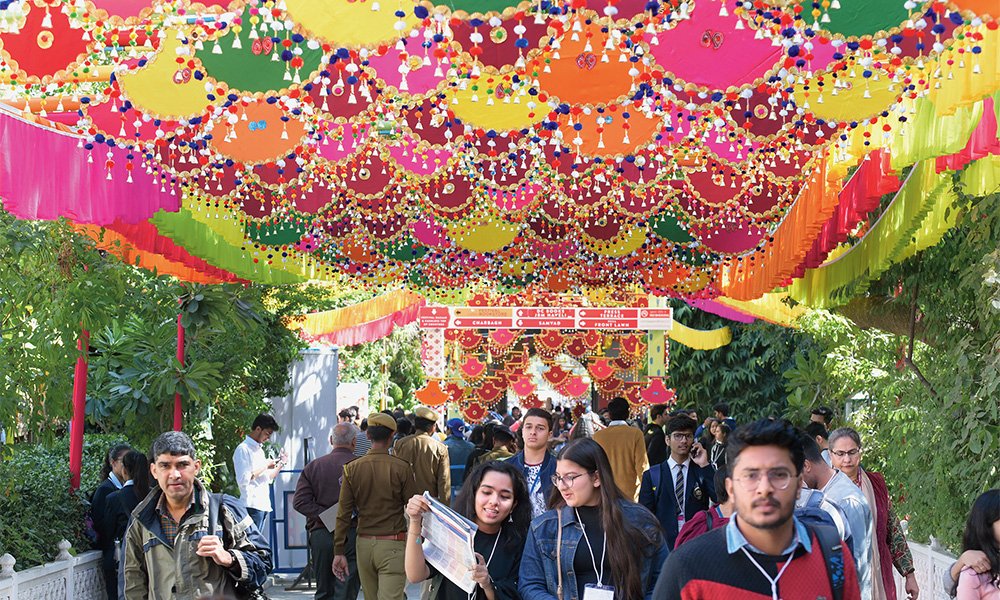
Asia's largest literary festival by attendance — held annually on the beaches of Kozhikode, India's first UNESCO City of Literature, drawing over 700,000 visitors across four January days for a programme that spans Nobel laureates and first-time authors, Malayalam poetry and global geopolitics, all entirely free.

Kozhikode, India 700K+ attended
Founded
2016
Frequency
Annual
Edition
9th edition
Next Edition
21–24 Jan 2027
Duration
4 Days
Claim this profile
◆  Atlas Commentary

The Kerala Literature Festival occupies a position unlike any other major literary festival in the world: it is simultaneously the largest literary gathering in Asia, the most demographically young, and the most structurally democratic. When 700,000 people converge on a beach in Kozhikode over four January days — 65 percent of them under 35, arriving from Kashmir to Kanyakumari and from the Middle East to Europe — they are participating in something that no other litfest on earth has managed: a mass public event that has lost none of its intellectual seriousness.

Culture Atlas Editorial ◈ Atlas Tier S Benchmark Updated 2026-08-18
●  Live — Culture Pulse
Festival Dates: 21 Jan 2027 Venue: Freedom Square, Kozhikode Beach (KLF permanent venue) Ticket Status: Free (with registration) Applications / Registration: Yes Theme: Literature & Storytelling|Democracy & Ideas|Malayalam Heritage|Global Voices|Science & Exploration|Environment|Cinema|Music & Poetry Status: Active
Last verified 2026-06-07
01

Scores

Atlas Team
National importance: High Global importance: High Regional importance: High
Scored across 8 dimensions by the Culture Atlas research team · last reviewed 2026-06-07. How is this scored? →
02

The Story

Organizer

The Kerala Literature Festival was born from a gap hiding in plain sight. Kerala has one of the highest literacy rates in India, a library movement that generated over 8,000 rural reading rooms, a publishing industry anchored by DC Books in Kottayam, and a citizenry whose relationship with the written word is among the most intense in the subcontinent. What it lacked, until 2016, was a public festival that placed books at the centre. Govind Deecee, editorial director at DC Books, has explained: being Malayalam publishers in a state that reads deeply, the team felt there was never an event that put books at the center despite the history of the state having a good library system and a good education system. The DC Kizhakemuri Foundation, established in 2001 to honour D.C. Kizhakemuri -- freedom fighter, publisher, the man who brought books to the masses at Rs 1.50 -- decided to fill the gap.

The first edition, in February 2016, was deliberately inclusive: not a prestige event for the literary establishment, but an open platform that anyone could attend. The Kozhikode beach was the venue -- a setting that sent a signal before a word was spoken. This was not going to be a conference hall festival.

Growth was rapid and structurally inevitable. Kerala's reading public had been waiting for exactly this. By the time Prof. K. Satchidanandan -- one of the most significant poets and critics writing in Malayalam and English -- became Festival Director, the curatorial ambition had clarified: KLF would be a genuinely multilingual platform, where Malayalam literature was celebrated as equal to any tradition in the world, while drawing the best international voices into conversation with it.

The Guest Nation feature -- each year a country receives focused attention with its writers, performers and cultural voices given prominent billing -- gave the festival a diplomatic dimension that few literary events possess. Spain, France, Germany, Turkey and others have participated, often in partnership with their cultural institutes, bringing international literary cultures into genuine dialogue with Malayalam writing.

By 2023, UNESCO designated Kozhikode as India's first City of Literature -- in November 2023, the first Indian city in the UNESCO Creative Cities Network. The Foundation and DC Books played an acknowledged role in demonstrating, through the festival's decade-long programme, that Kozhikode's relationship with literature was structural and sustained, not aspirational.

The 9th edition in January 2026 -- inaugurated by NASA astronaut Sunita Williams, with Nobel laureates Abdulrazak Gurnah, Olga Tokarczuk, and Abhijit Banerjee among the speakers, Germany as Guest Nation in partnership with the Goethe-Institut, and over 700,000 attendees across four days -- confirmed KLF's position as Asia's largest literary gathering. The 10th edition is confirmed for January 2027.

Cultural Significance

KLF's cultural significance has three distinct layers, each of which matters independently of the others.

The first is its relationship with Malayalam literature. Before KLF, Malayalam writing of genuine distinction — from the work of O.V. Vijayan to the poetry of K. Satchidanandan — reached its global audience primarily through academic channels and the occasional translated anthology. The festival has created a live, annual public forum in which Malayalam literature is both celebrated on its own terms and placed in dialogue with the world. The Nobel laureate and the debut Malayalam novelist share the same beach; that structural equality is the festival's most important curatorial statement.

The second layer is the UNESCO story. Kozhikode's designation as India's first City of Literature in November 2023 was not solely the product of KLF, but the festival's nine-year demonstration of Kozhikode as a city where half a million people gather for books was the most visible evidence the UNESCO committee could have received. The festival and the designation are now mutually reinforcing: KLF brings the world to a UNESCO City of Literature, and the UNESCO status brings additional credibility to KLF.

The third layer is the democratic model. In a country where access to serious intellectual life is heavily filtered by class, language, and institutional affiliation, a festival where 65 percent of 700,000 attendees are under 35, entry is free, and the language of the beach is Malayalam rather than English, is a genuine civic achievement. [Atlas Assessment]

Why It Matters Today

KLF matters today because it has demonstrated, at extraordinary scale, that the appetite for serious literature and ideas in a non-metropolitan, non-English-primary setting is not a niche interest but a mass cultural force. At a moment when Indian public discourse is narrowing in some dimensions and fracturing in others, a festival that draws 700,000 people to four days of multilingual, non-commercial, intellectually serious conversation is a significant counter-argument - not ideological but empirical. The people showed up. [Atlas Assessment]

Contribution To Culture

KLF has made three lasting contributions. It has created the largest sustained public platform for Malayalam literature in the world. It has been a primary catalyst - acknowledged by the DC Books team - for Kozhikode's designation as India's first UNESCO City of Literature. And it has established that a South Indian vernacular-language literary festival, structured around open public access, can achieve attendance and curatorial ambition that surpasses English-language festivals operating at much higher price points. That last achievement is the most replicable and the most important. [Atlas Assessment]

04

Evolution

Organizer
2016
The First Edition
DC Kizhakemuri Foundation stages the inaugural KLF in February 2016 on Kozhikode Beach. Debates, cultural activities, an art exhibition, a mini film fest, and a cookery show. Modest scale; the format's open, democratic character is established from the first day.
2017–2019
Rapid Growth
KLF grows dramatically with each edition, drawing progressively larger audiences. The curatorial scope expands - Nobel laureates, Booker Prize winners, and celebrated Indian authors join the programme. The beach venue becomes inseparable from the festival's identity. The Guest Nation feature is introduced, giving the festival an annual cultural diplomacy dimension.
2020–2021
Pandemic Disruption
COVID-19 forces KLF to cancel or significantly modify its January editions, ending the uninterrupted run of physical festivals. The Foundation adapts with digital programming. [Atlas Assessment]
2022 (5th Edition) - The Return: KLF returns to Kozhikode Beach after the two-year hiatus. The reception is exceptional - the city and Kerala's reading public demonstrate how deeply the festival has embedded itself in the cultural calendar. Attendance records are broken.
2023 (6th Edition) - Half a Million: The sixth edition sees 500,000+ attendees over four days. Nobel laureates, Oscar winners, and Booker Prize recipients feature. Spain is the Guest Nation.
2023 (November) - UNESCO City of Literature: Kozhikode is designated India's first UNESCO City of Literature. KLF's decade-long demonstration of the city's literary vitality is cited as a key factor. The festival and the designation become permanently linked in the city's identity.
2024 (7th Edition): 500+ speakers from across the globe. Turkey is the Guest Nation. The Friends of KLF premium membership programme is introduced.
2025 (8th Edition): 520 speakers, 500,000 attendees, 330 sessions across 7 venues. France is the Guest Nation. The festival self-describes as the largest literary event in the country.
2026 (9th Edition) - The 700,000 Edition: Inaugurated by NASA astronaut Sunita Williams alongside Kerala Tourism Minister Mohammed Riyas. Germany is the Guest Nation in partnership with the Goethe-Institut. 586 speakers from 18 countries, 350 sessions, 700,000 attendees across four days - the festival's largest edition to date. Nobel laureates Abdulrazak Gurnah, Olga Tokarczuk, and Abhijit Banerjee participate. Romila Thapar, Shashi Tharoor, Jimmy Wales (Wikipedia), Pico Iyer, and Indra Nooyi among the speakers.
2027 (10th Edition) - Milestone: Confirmed for 21–24 January 2027 at Kozhikode Beach. The 10th anniversary edition.
Defining Moments
The
??1.50 Legacy on a Beach (2016): The first edition of KLF on Kozhikode Beach is, from the outset, a tribute to D.C. Kizhakemuri's conviction that books belong to everyone. The setting - a public…
Half a Million on the Beach (2023): The sixth edition's attendance of
and that English is not required.
UNESCO City of Literature (November 2023): Kozhikode becomes India's f
year demonstration of the city's literary vitality. A festival creates a permanent institutional reality.
Sunita Williams Inaugurates (2026): A NASA astronaut opens Asia's larg
05

Atlas Perspective

Atlas Team
◆  Atlas Intelligence
KLF matters today because it has demonstrated, at extraordinary scale, that the appetite for serious literature and ideas in a non-metropolitan, non-English-primary setting is not a niche interest but a mass cultural force. At a moment when Indian public discourse is narrowing in some dimensions and fracturing in others, a festival that draws 700,000 people to four days of multilingual, non-commercial, intellectually serious conversation is a significant counter-argument - not ideological but empirical. The people showed up. [Atlas Assessment]
06

Programme

Organizer
Programming Pillars
Malayalam LiteratureGlobal LiteratureIdeas & PoliticsScience & EnvironmentCinema & ArtsMusic & PerformanceGuest Nation ProgrammeChildren & Youth
Signature Experiences
Guest Nation Cultural Programme (annual country focus)Kozhikode Beach Sessions (open-airsea backdrop)Nobel & Booker Laureate ConversationsMalayalam Literary CelebrationsCultural Nights (musicdancetheatre)Friends of KLF Priority SessionsFreedom Square (KLF's permanent beach venue)
Festival Components & IPs
Author TalksPanel DiscussionsBook LaunchesPoetry ReadingsFilm ScreeningsMusic ConcertsTheatre PerformancesCultural NightsWorkshopsChildren's ProgrammePolitical & Social DebatesScience & Technology Sessions
Formats
ConversationPanel DebateSolo TalkReadingPerformanceCultural NightWorkshopChildren's Session
Key Themes
Literature & StorytellingDemocracy & IdeasMalayalam HeritageGlobal VoicesScience & ExplorationEnvironmentCinemaMusic & Poetry
Cultural DNA
Malayalam LiteratureBooksIdeasPoetryDemocracyUNESCO City of LiteratureBeach FestivalSouth IndiaMultilingualFree
Ecosystem Role
Primary public literary institution of Kerala; the catalyst for Kozhikode's UNESCO City of Literature designation; the largest free literary platform in South Asia
07

Audience Intelligence

Organizer
700,000+ (2026 edition, 9th); 500,000+ (2025, 8th)
Attendance
Growing
Trend
Readers, students, writers, academics, families, cultural tourists, diaspora, general public
Audience Type
Medium
HNI Presence
8.8/10
Quality Score
35%
First-Time Visitors
[Atlas Estimate] Millions via DC Books YouTube, social media, and KLF app
Digital Audience
High
Creator Presence
Medium
Influencer Presence
Audience Geography
Pan-India (Kashmir to Kanyakumari); substantial Gulf and global diaspora; growing international visitor base
Visitor Origin
Kerala-wide; pan-India (particularly Southern states, Delhi, Mumbai); Gulf diaspora; international (primarily Europe, USA, Gulf)
Domestic
9
International
1
Students
4.5
Families
3
Age Distribution
18–24
30%
25–34
35%
35–49
22%
50+
13%
Income Distribution
< ₹5L
40%
₹5–15L
35%
₹15–50L
20%
₹50L+
5%
Audience Analysis

The Kerala Literature Festival's audience is its most radical programmatic statement. When the festival records that 65 percent of its attendees are under 35, arriving from across India and the global diaspora for four free January days on a beach in Kozhikode, this is not marketing - it is the most verifiable evidence available that serious literary culture has a genuine mass audience in India when the price and language barriers are removed.

The demographic profile is structurally different from most international literary festivals. Where Hay Festival skews 50+ and affluent, KLF skews young and broadly economically representative - the free entry model, the beach setting, the Malayalam primary language, and the non-metropolitan location combine to produce a visitor profile that includes school students from Kozhikode, academics from Delhi and Mumbai, authors from Europe and the Gulf, and Malayali diaspora families making annual pilgrimages from the Middle East for the festival.

09

Tourism Intelligence

Shared · Verified
National
Destination Appeal
Transformative
Tourism Impact
9.2/10
Cultural Tourism
[Atlas Estimate] Very significant - Kozhikode's hotels, restaurants, transport and retail absorb 700,000 festival visitors over four January days, generating tens of crores of economic activity in one of Kerala's principal cultural and commercial cities. Precise figure not publicly published.
Economic Impact
Tourism Analysis

KLF's tourism impact is exceptional not only in scale but in composition. A festival drawing 700,000 visitors over four days to a mid-sized coastal city - without a theme park or a beach resort package - is creating cultural tourism of a kind that destination marketers dream about: motivated, high-engagement, economically distributed visitors who are there for the content, not the infrastructure.

Kozhikode's tourism proposition is substantially enhanced by KLF. Before the festival, the city's attractions - its Zamorin history, its Portuguese heritage, its role in the spice trade, its association with Vasco da Gama's 1498 landing - were underutilised relative to their cultural weight. The festival has brought those heritage dimensions into a live public frame. The beach setting at Freedom Square, adjacent to the lighthouse on Beach Road, is now both a festival venue and a tourist destination in its own right.

In the Press

More coverage on Google News →
10

Media Intelligence

Atlas Team
High
Media Visibility
National and regional television; Malayalam news channels provide extensive live and recorded coverage; national English-language channels feature headline sessions
TV Coverage
High
Digital Reach
[Data Not Publicly Available]…
Media Partners
Media Analysis

KLF generates media coverage on a scale commensurate with its extraordinary attendance figures. Malayalam news channels - which have large, highly engaged audiences across Kerala and the Gulf diaspora - treat the festival as a major January event, covering inauguration, sessions, and speakers in depth. The national English-language press covers the headline participants (Nobel laureates, Sunita Williams, Shashi Tharoor) and the attendance figures.

The festival's most distinctive media asset is the DC Books publishing and digital infrastructure. DC Books' YouTube channel has a substantial subscriber base; its social media platforms drive organic reach for festival content that is not available to most festival organisers. The session recordings and speaker interviews distributed through these channels extend the festival's intellectual content well beyond the four January days.

11

Visit

Organizer
Freedom Square, Kozhikode Beach (KLF permanent venue)
Venue
Kozhikode, Kerala
Location
January · 4 Days
When
Free (with registration) · Free (standard registration)–₹1,199 (Friends of KLF premium membership - priority sessions, goodies bag)
Entry
Selected sessions streamed on DC Books and KLF social media platforms; KLF mobile app available
Live Streaming
Yes
Registration
Address
Freedom Square, Beach Road, near Calicut Lighthouse, Kozhikode, Kerala 673032
Get Directions →
How To Get There
Kozhikode is exceptionally well-connected. Calicut International Airport is 30km away (approximately 45 minutes by taxi), with direct flights from major Indian cities and extensive Gulf connections - critical for the large Malayali diaspora audience. Kozhikode Railway Station, 3km from Freedom Square, sits on the Shoranur–Mangaluru main line with daily trains from Chennai, Bangalore, Mumbai, and beyond. Within the city, auto-rickshaws and taxis serve all festival venues. The festival provides shuttles between dispersed session venues during the four festival days. Walking from the city centre to Freedom Square is feasible; the beachfront road is well-lit and navigable.
Nearest Transport
Airport: Calicut International Airport (Karipur) - 30km from Kozhikode Beach; well connected to Delhi, Mumbai, Bangalore, Chennai, Hyderabad and Gulf cities · Railway: Kozhikode Railway Station - approximately 3km from venue; excellent rail connectivity across Kerala and to major Indian cities
Best Time To Visit
All four days; opening day for inaugural energy; final day for the extraordinary atmosphere of multiple-lakh crowds on the beach. Arrive early for popular sessions - demand consistently exceeds venue capacity for headline speakers.
Weather
Dry and warm January weather (26–32°C); Kozhikode's post-monsoon winter is reliably pleasant - ideal for outdoor beach sessions and evening cultural programmes
Travel Advisory
Kozhikode hotels and homestays fill months in advance for the festival period; book early. January is peak tourist season in Kerala; road traffic into the city is significant during KLF.
Facilities
Multiple tented and open-air stagesFood stallsBook fairAuthor signing areaChildren's zoneFirst aidShuttle buses between venuesFriends of KLF loungeMobile app navigation
Amenities
Food AvailableFamily FriendlyPublic Transport Access
Nearby Attractions
Kozhikode Beach & LighthouseVasco da Gama Landing Site (Kappakadavu15km)Beypore Beach & historic portMananchira SquareSweet Meat Street (Mithai Theruvu)Tali TempleSM StreetKadalundi Bird Sanctuary
Nearby Restaurants
Zains Hotel (famous Malabar biryani)Paragon RestaurantSagar (seafood)Beach Road food stalls during festivalSaleems RestaurantCity hotel restaurants
12

Ecosystem

Atlas Team
Cultural Influence
The primary institutional argument for Kozhikode's UNESCO City of Literature designation; the model demonstrating that a South Indian vernacular-language literary festival can achieve mass-attendance scale without English as its operating language
Comparable Festivals
Jaipur Literature FestivalHay FestivalEdinburgh International Book FestivalKolkata Literary MeetSydney Writers Festival
Related Festivals
Mathrubhumi International Festival of Letters (MBIFL)Bangalore Literature FestivalKerala School Kalolsavam
Partner Institutions
DC Kizhakemuri FoundationDC BooksGovernment of KeralaKerala TourismGoethe-Institut (Guest Nation partner)Various national cultural institutes as Guest Nation partnersBritish Council (programming)Goethe-InstitutInstituto CervantesAlliance FrançaiseGuest Nation cultural institutes annually
Type Festival
Atlas Verified Yes
Last Updated 2026-08-18
Connected Discoveries

Connected Discoveries

Continue your journey through India's cultural landscape.