Origin & evolution
Yakshagana's origins are traced to the devotional culture of the Tulu Nadu region of coastal Karnataka, where performances were part of the ritual calendar associated with the Tulu year and with the festivals of the region's powerful local deity traditions. The form is believed to have crystallised in its current form between the 15th and 17th centuries, though it draws on older performance traditions and has been shaped by the influence of the Sanskrit theatre tradition, the Shaivite and Vaishnavite devotional movements, and the court cultures of the Keladi Nayaka and Vijayanagara kingdoms.
The performance tradition was historically sustained by troupes (melas) that toured the villages and towns of coastal Karnataka during the festival season (November to May), performing in open-air settings near temples on temporary bamboo stages. The system of patronage was partly temple-based and partly community-based, with individual village patrons (yajamanas) commissioning specific performances as vows or gifts to deities.
The 20th century saw significant changes in Yakshagana's performance context. The traditional touring mela system has declined but not disappeared; alongside it, urban performances in proscenium theatres and institutional Yakshagana schools have developed new audience and practitioner communities. Several research and training institutions were established in the Udupi and Mangaluru region from the 1960s onwards to systematise the tradition's training and document its repertoire.
Why Yakshagana
A Yakshagana performance typically begins at dusk and continues through the night until dawn, following a single story drawn from the Hindu epics or the Puranas. The performance has a fixed structural framework: the Bhagavata (the storyteller-narrator-singer) sits on one side of the stage with the percussion and harmonium players, singing the composed verse (prasanga) that drives the narrative. The performers enter as characters, dancing to the music and then delivering improvised dialogue (mattu) in response to the narrative situation.
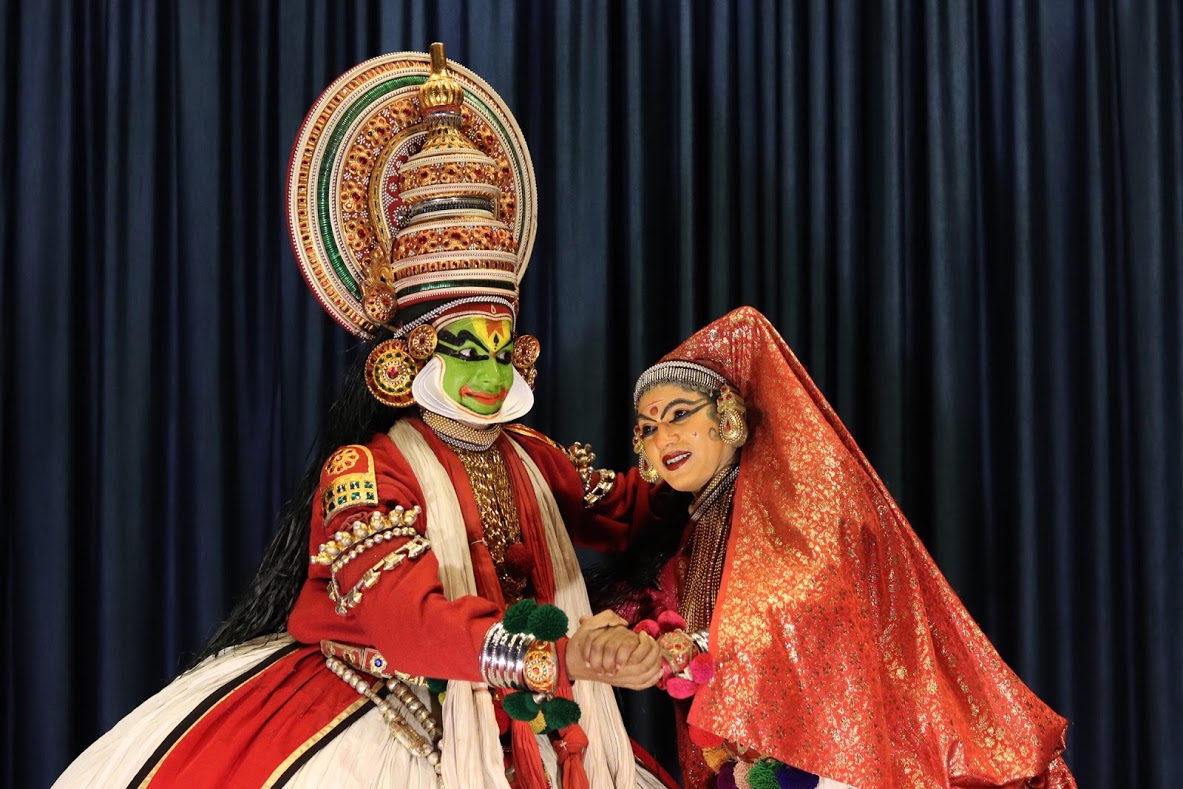
The costume and makeup are among the most elaborate of any Indian theatre form. The headdresses (mundasa), face paintings and costumes are character-specific and encoded: an audience member familiar with the tradition can identify a character's nature (divine, heroic, demonic, comic) from their appearance before a word is spoken. The aesthetic registers range from the sublime to the grotesque, with the demonic characters (asuras, rakshasas) wearing masks and elaborate ornaments designed to convey their supernatural power.
Improvisation within a fixed narrative framework is the heart of the form. The performers know the story and their character's role within it; how they play out the dialogue, what arguments they make, what humour they introduce, and how long they sustain any given scene is entirely improvised in response to the audience and the moment. Accomplished Yakshagana dialogue actors (veshadaris) are celebrated for the wit, classical learning and rhetorical skill they bring to the improvised passages.
The tradition & its craft
Yakshagana exists in two main regional styles (paddhati): Badagu Thittu (northern style) and Thenku Thittu (southern style), with the northern style the more widely known. Within these styles, there are distinct schools associated with major troupes and training centres, particularly in the Udupi and Dharmasthala regions.
Kasaragod Chhaya Nataka Kendra and the Udupi-based Yakshagana institutions have been significant in the systematic transmission of the form outside the traditional hereditary troupe context. Guru Vasu Yakshagana Kendra and several other training schools have trained hundreds of practitioners in the last three decades. The Yakshagana Research Centre established in Udupi in the 1970s by K.S. Upadhyaya was one of the first systematic documentation and research institutions for the form.
Types & forms
Masters across the generations
Signature works
In cinema & popular culture
Yakshagana's elaborate visual aesthetic has been referenced in several Kannada and Tulu language films. Its headdresses and makeup have been used in film contexts to signify the coastal Karnataka cultural identity. A significant documentary tradition on Yakshagana exists in both Kannada and English, including documentaries produced by Doordarshan and by Udupi-based cultural institutions.
Contemporary presence
Yakshagana's contemporary situation is one of the most positive of any Indian folk theatre tradition. The traditional touring mela system continues to operate, with dozens of professional troupes performing across the festival season. Simultaneously, institutional training schools, a research infrastructure, and urban performance circuits have created a large community of practitioners and a significant audience beyond the traditional regional base. The Yakshagana Research Centre in Udupi, the Yakshagana Kala Pratishthana and several other bodies provide documentation, training and platform. The form has not suffered the audience collapse seen in many comparable folk theatre traditions.
Across the regions
Yakshagana is concentrated in the coastal districts of Karnataka: Dakshina Kannada (Mangaluru district), Udupi, Uttara Kannada (Karwar area) and extending into parts of the Kasaragod district of Kerala. It is not practised outside this geographic belt in its traditional form, making it the most regionally concentrated of any performing tradition in the Culture Atlas. The Udupi and Mangaluru regions together constitute its institutional and performance heartland.
Urban performances in Bengaluru and other Karnataka cities have extended its audience beyond the coastal belt. International performances have been organised through Karnataka's cultural diplomacy programmes.
Where it lives
Recognition & status
Further reading
The Atlas perspective
Yakshagana connects on the Culture Atlas graph to the Bengaluru destination profile (urban performance venue), to Karnataka's cultural geography (Udupi and Mangaluru as primary centres when those destination profiles are built), and has related_to connections to Kathakali (shared south Indian martial aesthetic) and Koodiyattam (shared south Indian classical theatre lineage). The form's score of 8.5 reflects its exceptional living practice and institutional depth.